
Stop Prompting AI. Start Building Loops. Why Boris Cherny Thinks the Future Is AI Orchestrating AI
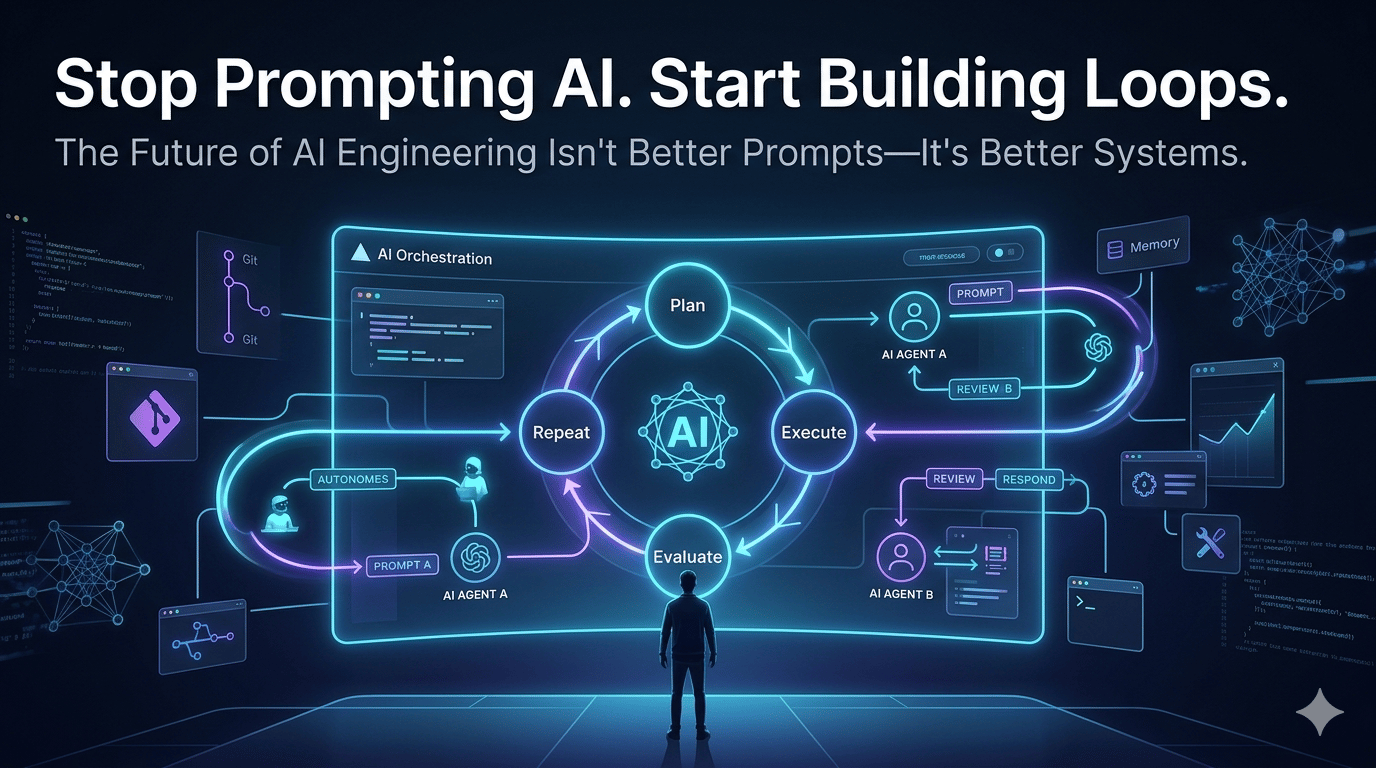
If you run a FinTech, HealthTech, or B2B SaaS company, the AI question is rarely "what is the best prompt?" It is whether your systems can plan, execute, verify, and recover without someone babysitting every step. Boris Cherny, who leads Claude Code at Anthropic, recently said he no longer prompts Claude directly. He builds loops instead. That is the shift from prompt engineering to production AI orchestration — and it is the framing founders should use when evaluating build vs. buy.
"I do not prompt Claude anymore. I have loops running that prompt Claude and figure out what to do. My job is to write loops."
Read that again. The person building one of the world's most capable AI coding assistants no longer spends his day chatting with AI. He builds systems that let AI talk to itself. That statement represents one of the biggest mindset shifts in AI engineering.
Prompt Engineering Was Never the End Goal
Prompt engineering solved a temporary problem. Large language models were powerful, but they needed humans to tell them exactly what to do every single step of the way. User -> Prompt -> LLM -> Answer. That workflow works well for:
- brainstorming
- writing
- debugging
- answering questions
But it falls apart when the task lasts for hours instead of minutes. Real software projects do not end after one response. Neither do research, design, testing, or code reviews.
The Rise of Loop Engineering
Instead of asking AI one question after another, Boris builds loops. A loop repeatedly asks four questions:
- What is the goal?
- What is the next best action?
- Execute it.
- Did that move us closer to the goal?
Notice something interesting. The human is not involved in every iteration. The AI decides its own next prompt.
Prompts Become an Internal Implementation Detail
This is the biggest conceptual shift. The human no longer writes prompts. The orchestrator does. Instead of: Human -> AI, we now have: Human -> Goal -> Orchestrator -> ["AI Planner", "AI Coder", "AI Reviewer", "AI Tester"]. Each AI generates prompts for the next AI. Humans define objectives and guardrails.
This Is How Claude Code Actually Feels
If you have used Claude Code, Cursor, Codex, or Gemini CLI recently, you have probably noticed something. You are writing fewer instructions. Instead, you are giving goals. For example: Build authentication. The agent then decides to:
- inspect the repository
- understand the framework
- create a plan
- modify files
- run tests
- fix failures
- review changes
- repeat until complete
You did not tell it every step. The loop did.
AI Is Becoming Its Own Project Manager
Think about a senior engineering manager. You do not tell them:
- open VS Code
- create a file
- write line 14
- rename variable X
You give them an outcome. They coordinate the work. Loops bring that same abstraction to AI. Instead of programming responses, you are programming workflows.
The Skills That Matter in Production
This changes what "AI engineering" actually means for teams shipping real products. Old skills:
- prompt writing
- prompt optimization
- clever wording
New skills:
- orchestration
- state management
- memory systems
- evaluation loops
- tool selection
- planning
- retries
- verification
- multi-agent coordination
The prompt has not disappeared. It is just no longer the interface humans spend most of their time touching.
Why Loops Produce Better Results
One-shot prompting assumes the first answer is good enough. Real engineers know that is rarely true. Loops enable:
- critique
- refinement
- retries
- testing
- validation
- self-correction
Instead of asking: "Write a login system.", the orchestrator can ask:
- Did the tests pass?
- Are there security issues?
- Can performance improve?
- Is the code idiomatic?
- Should another agent review this?
The result is often dramatically better than a single prompt.
Production Loops vs. Demo Prompts
Founders evaluating AI often get sold on a chat interface when what they need is a closed loop with measurable outcomes: task success rate, human-in-the-loop checkpoints, and unit economics that survive contact with real users. Prompts are one step inside that loop — not the product.
That is the difference between a demo and a system your business runs on. In client work I have shipped:
- Scintia — a B2B voice AI platform with role-based portals, billing, and telephony, delivered over 16 months of production engineering.
- Zoomlion lead generation — a 68-node n8n automation pipeline that tripled qualified B2B lead throughput without anyone touching a spreadsheet.
Both are loops in practice: ingest context, decide the next action, execute, verify, and repeat until the business outcome is met.
This Mirrors How Humans Work
Good engineers do not produce perfect code on the first attempt. They iterate. Write. Review. Test. Refactor. Repeat. Loops automate that cycle. The AI is not becoming smarter because of a magical prompt. It is becoming more reliable because it is allowed to think in iterations.
The Future Is Workflow Engineering
The winners will not necessarily be the people who write the cleverest prompts. They will be the people who build systems where AI agents can:
- plan
- execute
- verify
- recover
- collaborate
- improve continuously
In other words: the prompt is becoming infrastructure. The workflow is becoming the product.
What to Do Next
Boris Cherny's statement is not a rejection of prompt engineering. It is an evolution of it. Prompts still exist — they are just written by software instead of humans.
If you are deciding whether to build agent loops into your product or operations:
- Stop asking: "What is the best prompt?"
- Start asking: "What is the best system — and how will we measure it?"
That is the question defining the next generation of production AI. If you want a technical partner who has shipped these loops in FinTech, HealthTech, and B2B SaaS, get in touch or browse selected work.